
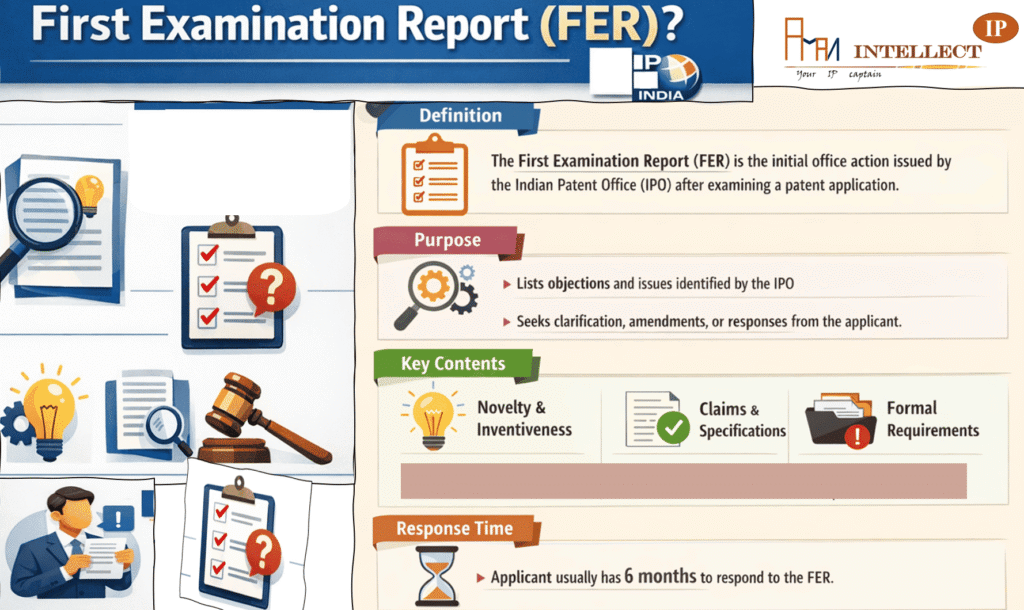
The First Examination Report (FER), issued by the Indian Patent Office (IPO), is a detailed evaluation of the patent application, consisting of formal and technical or substantive objections. The FER is issued only after filing a Request for Examination (RFE), it is mandatory to file the RFE for the patent application to get examined. After the Patent Amendment Rule 2024, the RFE must be submitted within 31 months from the priority date.
According to Section 12 (1) of the Patents Act, 1970, when a request for examination has been made in respect of an application for a patent in the prescribed manner, the patent application shall be referred at the earliest by the controller to an examiner for making a report to him in respect of the following matters, namely:-
(a) whether the application and the specification and other documents relating thereto are in accordance with the requirements of this Act and of any rules made thereunder;
(b) whether there is any lawful ground of objection to the grant of the patent under this Act in pursuance of the application;
(c) the result of investigations made under section 13; and
(d) any other matter which may be prescribed.
The Controller generally considers the report of the examiner within one month from the date of receipt, referred to as the First Examination Report (FER).
The First Examination Report (FER) is mainly divided into four different sections consisting of:
1. Summary of the Report: The summary part provides the bibliography details of the patent applications, and the list of objections raised in FER, for e.g., novelty, inventive step, industrial applicability, non-patentability, and formal objections.
2. Detailed Technical Report: The second part of the Examination report explains the reasons behind the technical objections mentioned in the summary in detail. This section generally lists the cited prior art documents, either patent or non-patent literature, or both, which are similar to the current patent application.
More particularly, this section pertains to the objections on inventive step, non-patentability, sufficiency of disclosure and definitiveness.
3. Formal Requirements: In this section, the details related to the formal requirements are mentioned. This section lists the pending forms, official requirements and the formal corrections required (if any).
4. Documents on Record: This section mentions the list of documents along with their docket number and docket date on which the examination report is based, along with the last date for filing the response to the FER.
The applicant is required to comply with all the requirements imposed upon him by the Patents act, 1970 as communicated through FER or subsequent communication, in the form of a written response within six months from the date of issuance of FER. The applicant generally has six months from the FER’s issuance to submit the response, with the option to request a three-month extension by filing Form 4 and paying the required fee. Failing to respond within this nine-month window risks the patent application, if the applicant fails to respond to the FER within the prescribed time, the application is deemed to have been abandoned under Section 21(1) and notice and/or a letter is sent to the applicant for the same. A timely, well-crafted response keeps the application active and can expedite the process, minimizing delays in a system where patent grants often take years.

Authors:-
Kashvi Singh | Intern
Aman Kumar | Partner
________________________________Contact Us__________________________________